
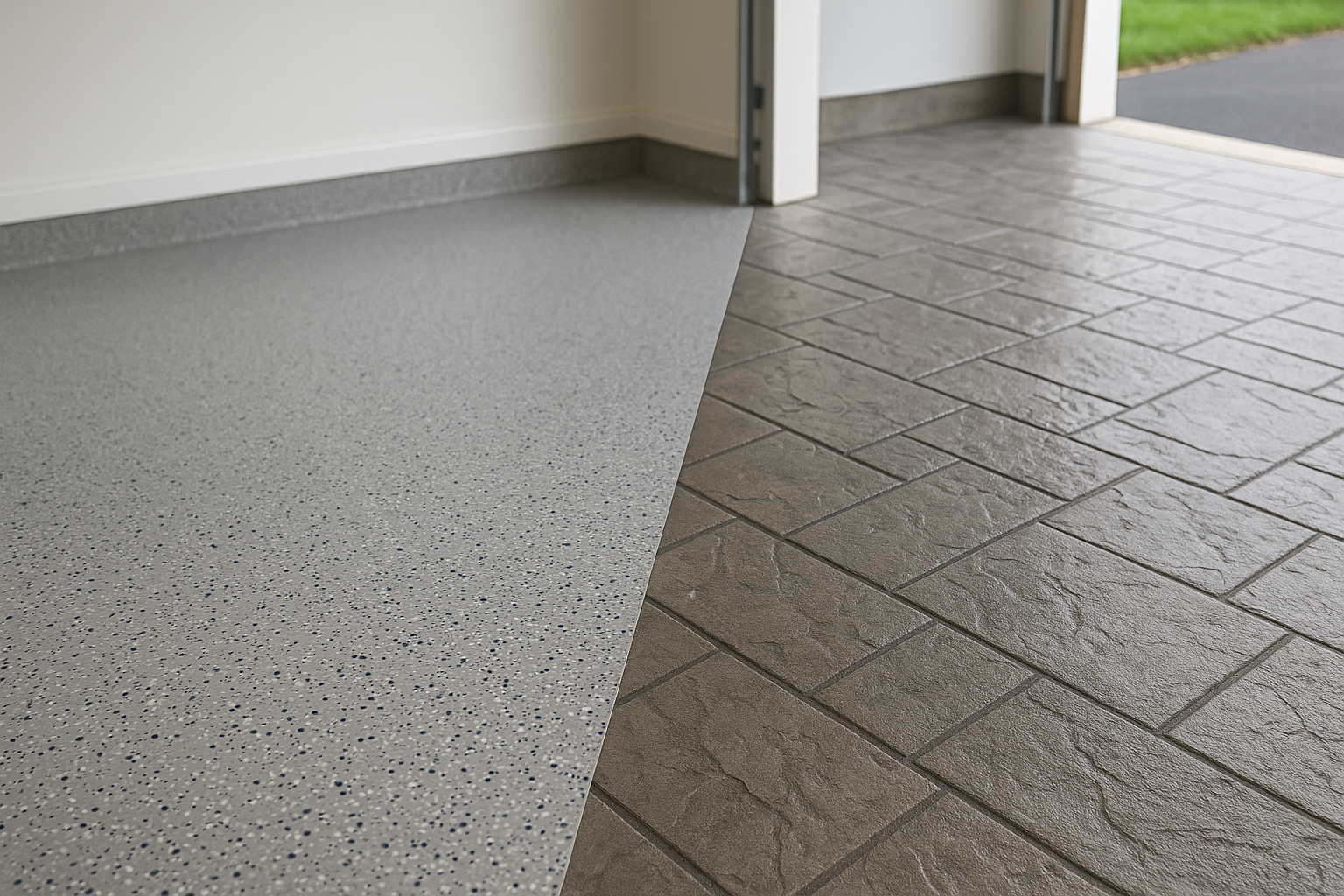
Epoxy Garage Floors vs. Stamped Concrete: Which is Better?
Epoxy and stamped concrete rarely compete for the same square footage, which is why this comparison trips up so many homeowners. An epoxy garage floor is a coating bonded to an existing slab, while stamped concrete is a decorative texture pressed into fresh concrete, usually on a patio, walkway or driveway apron. Inside a garage, epoxy almost always makes more sense; outside, stamped concrete handles sun, salt and foot traffic far better.
The useful question is not which product is better in the abstract, but which one belongs on the surface you are standing on. Below is how the two compare on cost, winter performance, slab requirements and ten-year upkeep in southeastern Pennsylvania conditions.
What Each Surface Actually Is
Epoxy is a two-part resin and hardener that cures into a plastic-like film roughly 10 to 40 mils thick, depending on whether it is a thin roll-on kit or a full broadcast system with flakes and a topcoat. It does not soak into the slab the way a penetrating sealer does, so the bond depends entirely on surface prep.
Stamped concrete is structural concrete, typically 4 inches thick over compacted stone, that gets color hardener, a release agent and rubber mats pressed into the surface while it is still plastic. The pattern becomes part of the slab rather than a layer sitting on top of it, which is why stamped patterns that mimic natural stone hold their look for decades with only periodic resealing.
- Epoxy coating: applied to cured concrete, interior use, 1 to 3 days of install plus cure time.
- Stamped concrete: poured new, exterior use, 1 day of placement plus 28 days to reach full strength.
- Polished concrete: a third option, grinding and densifying an existing slab rather than coating it.
How Each One Handles a Pennsylvania Winter
Montgomery and Bucks County slabs go through roughly 40 to 60 freeze-thaw cycles a year, and that number drives most failures we see. Road salt dragged in on tires sits in puddles on a garage floor and works into any pinhole in a coating, so epoxy that was installed over a dirty or damp slab starts peeling in flakes near the overhead door.
Exterior concrete has the opposite problem: water absorbs into the surface, freezes, and spalls off the top layer. Air-entrained concrete placed per Portland Cement Association guidance resists that far better, and a quality penetrating sealer reapplied every two to three years is the difference between a patio that looks sharp at year 15 and one that is pockmarked at year 6.
Deicing salts are harder on new exterior concrete than most people expect. Most contractors, including ours, ask homeowners to skip salt entirely during the first winter and use sand for traction instead.
Cost Comparison for a Two-Car Garage and a 400-Square-Foot Patio
Pricing in the Lansdale, Souderton and Skippack area has settled into fairly predictable ranges, though slab condition can push any of these numbers higher.
- DIY epoxy kit: $200 to $600 for a 400 to 500 square foot garage, plus a weekend of grinding and etching.
- Professional epoxy flake system: $3 to $8 per square foot, so roughly $1,400 to $3,500 for a typical two-car garage floor.
- Polyaspartic or polyurea topcoat system: $5 to $12 per square foot, with a one-day install and next-day vehicle traffic.
- Polished concrete: $4 to $10 per square foot for a basic grind, dye and densify, higher for exposed aggregate finishes.
- Stamped concrete: $14 to $24 per square foot installed in 2026, including excavation, base stone, reinforcement, color and sealer.
The spread between epoxy and stamped concrete looks dramatic until you remember stamped pricing includes a brand new structural slab. Comparing a coating to a pour is comparing paint to the wall behind it.
Where Polished Concrete Fits Into the Decision
Polished concrete gets left out of most of these comparisons, and it deserves a seat at the table for garages and basements. A ground and densified slab cannot delaminate because there is nothing sitting on top to peel, which matters in basements where moisture vapor moves up through the slab year-round.
The tradeoff is stain resistance. Polished concrete repels water reasonably well once densified and sealed, but brake fluid, battery acid and dropped oil can leave shadows that epoxy would have shrugged off. Shops and home gyms tend to favor polished; working garages with vehicles on jack stands usually favor a flake-and-topcoat system.
Slab Condition Decides More Than Style
Before anyone picks a color, the existing concrete garage floor needs an honest evaluation. The American Concrete Institute recommends moisture testing before installing any impermeable floor covering, and that single test prevents the most common and most expensive epoxy failure.
- Tape a plastic sheet down for 24 hours; condensation underneath means vapor is moving through the slab and a standard epoxy will likely blister.
- Check for hot tire pickup on any existing coating or paint; if the old finish lifts when tires cool, it has to come off completely.
- Measure cracks. Hairlines can be filled, but anything over 1/4 inch wide or with vertical displacement signals a base problem under the slab.
- Confirm mechanical profile. Diamond grinding to a CSP 2 or 3 profile beats acid etching every time, and skipping it is why so many kits fail inside two years.
If the slab is heaving, badly spalled or sinking at a corner, coating it is throwing money at a symptom. In that case a replacement pour, or in some cases building fresh as part of a new freestanding garage or workshop, puts you further ahead.
Ten-Year Maintenance, Side by Side
Epoxy cleans up with a dust mop and a pH-neutral cleaner, and it resists most automotive chemicals if they are wiped up the same day. Expect to recoat a quality professional system somewhere between year 8 and year 15, and sooner near the garage door where UV exposure yellows standard epoxy.
Stamped concrete needs resealing every two to three years, which runs roughly $0.75 to $2.00 per square foot. Skip it and the color fades, efflorescence shows up as a white haze, and the surface loses the wet-look sheen most homeowners paid for in the first place.
Repairs tell a different story. A chipped epoxy patch can be feathered and recoated in an afternoon, while a cracked stamped slab is difficult to match because the color and pattern were integral to the original pour.
Choosing Based on Where the Surface Lives
- Interior garage with a sound slab: epoxy flake or polyaspartic, for the chemical resistance and easy cleanup.
- Basement or home gym: polished concrete or a vapor-tolerant coating, after moisture testing.
- Patio, pool deck or walkway: stamped concrete, which holds up to UV and freeze-thaw that would destroy a coating.
- Driveway and apron: broom-finished or stamped concrete, never epoxy, since coatings cannot survive salt, plows and tire scrubbing.
- Covered porch: either works, though stamped overlay gives more design flexibility.
Homeowners comparing outdoor options usually end up looking at real installations nearby. Our stamped concrete work in Souderton and projects around Skippack show how pattern scale and color change the way a patio reads next to different siding and stone.
Frequently Asked Questions
What Is the Downside of an Epoxy Garage Floor?
The biggest downside is that epoxy fails when moisture moves up through the slab, and that failure shows up as bubbling or peeling within 1 to 3 years. Standard epoxy also ambers under direct sunlight, gets slippery when wet unless an anti-skid aggregate is broadcast into the topcoat, and requires 3 to 7 days of cure time before vehicles return.
What Is the Average Cost to Epoxy a Two-Car Garage Floor?
A professional epoxy flake system on a 400 to 500 square foot two-car garage runs about $1,400 to $3,500, or $3 to $8 per square foot. DIY kits cost $200 to $600, but the savings disappear if the slab needs diamond grinding, crack repair or patching first.
What Is Considered the Best Garage Floor Coating?
Most installers now consider a polyaspartic or polyurea topcoat over an epoxy basecoat the best garage floor coating, at $5 to $12 per square foot. It cures fast enough to walk on in hours and drive on the next day, resists UV yellowing, and stays flexible in cold weather better than straight epoxy.
What Is the Downside of Stamped Concrete?
Stamped concrete needs resealing every 2 to 3 years and will eventually crack, since all concrete cracks and control joints only direct where it happens. It can also be slick when wet without a non-slip additive in the sealer, and repairs are hard to color-match to the original pour.
Get a Straight Answer on Your Slab
A 20-minute look at your existing concrete tells us whether a coating will hold or whether you are better off pouring new, and that assessment costs nothing. Call Wolfpack Home Services to walk your garage, patio or driveway and get written pricing on stamped concrete across Montgomery County or the right floor system for the space you actually use.