
October 25, 2026
How to Mix Metal Finishes in Your New Kitchen
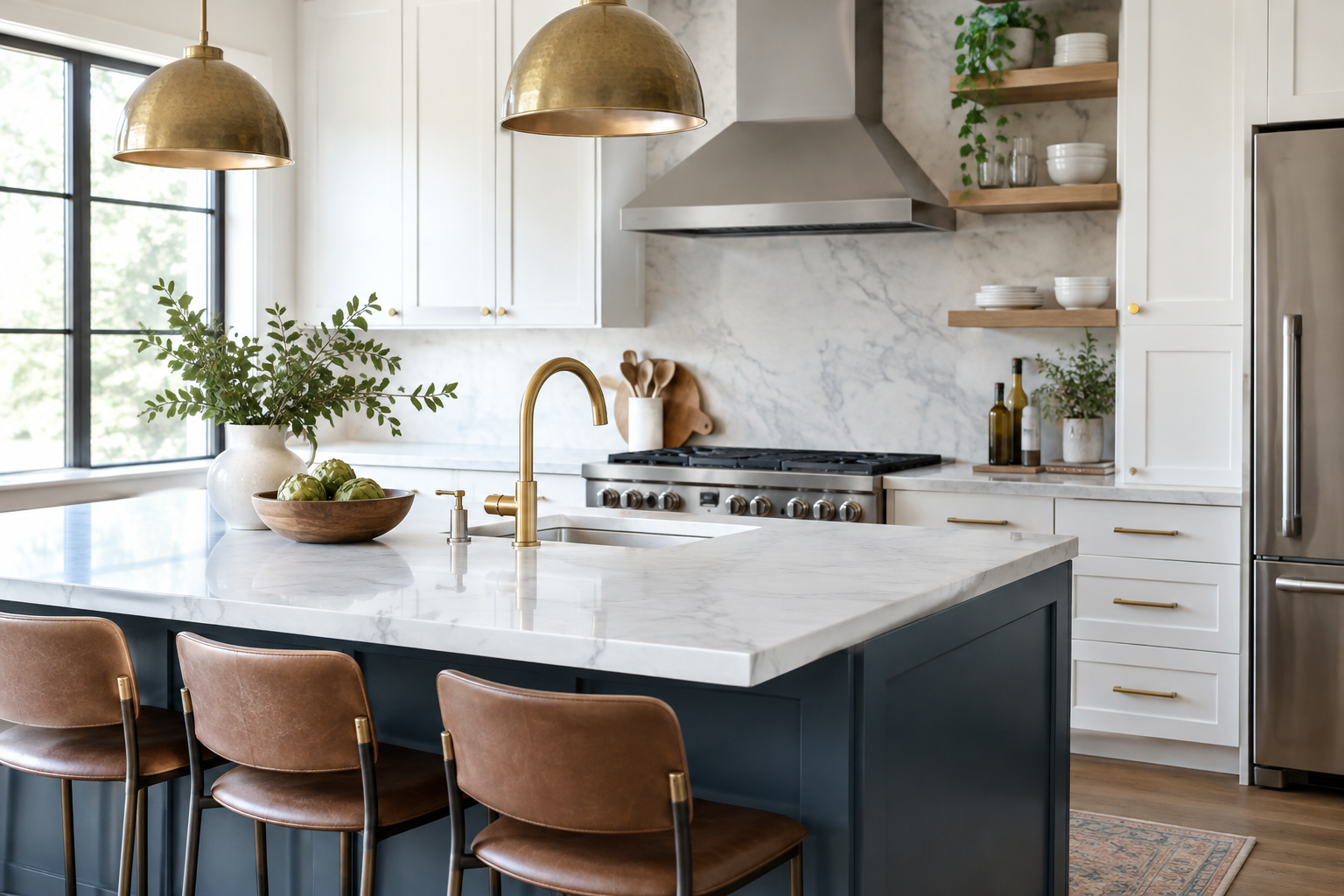
Most designers cap a single kitchen at three metal finishes, and the combination only reads as deliberate when one of them clearly leads. Figuring out how to mix metal finishes in your new kitchen is less about taste and more about ratios, undertones and placement, which is good news because all three can be planned on paper before a single pull gets ordered. Get those pieces right and matched sets start to look flat by comparison.
Three Metals Is the Working Limit
Two metals is the safest mix, three is where most well-photographed kitchens land, and four starts to look like the previous owner replaced things one at a time. The count includes everything visible: cabinet hardware, faucet and pot filler, light fixtures, sink, appliance handles, range trim, even the stools at the island.
A common breakdown in a 200-square-foot kitchen looks like this:
- Dominant metal (roughly 60%): cabinet hardware, since 30 to 45 knobs and pulls carry more visual weight than anything else in the room.
- Secondary metal (roughly 30%): plumbing, meaning the faucet, pot filler and sometimes the sink itself.
- Accent metal (roughly 10%): pendant lights over the island, a range hood strap, or open shelf brackets.
Stainless appliances are the exception almost everyone forgets. If your refrigerator, range and dishwasher are stainless, treat that as a neutral background rather than one of your three choices, the same way white walls do not count as a paint color in your scheme.
Read the Undertones Before You Read the Name
Finish names are marketing. Two products both labeled “brushed brass” can sit a full step apart in warmth, so the undertone is what actually decides whether a mix works.
- Warm metals: unlacquered and satin brass, antique bronze, copper, champagne bronze.
- Cool metals: polished chrome, stainless, brushed nickel with its faint yellow shift, pewter.
- Neutral bridges: matte black, graphite, oil-rubbed bronze that has gone nearly black.
The most reliable pairing in new kitchens is one warm metal plus one cool or neutral, such as satin brass hardware with matte black plumbing, or polished nickel faucets with aged brass pendants. Avoid pairing two metals from the same family that are only slightly different, because brushed nickel next to stainless and polished chrome next to satin chrome just look like near misses.
Order physical samples. A single knob and a faucet spout cost under $60 together, and seeing them against your actual cabinet door in your own north- or south-facing light will tell you more than any product photo.
Assign Metals by Zone, Not at Random
Mixed metals look accidental when the same two finishes alternate across one run of cabinets. They look designed when each finish owns a zone or a function.
Three approaches that hold up well:
- By plane: one metal on everything vertical (cabinet hardware, wall sconces), a second on everything that touches water (faucet, soap dispenser, filtered water tap).
- By island versus perimeter: perimeter cabinets in nickel, island in brass, with the island pendants tying back to the brass. This is the approach you see repeatedly in Studio McGee style kitchens and photographed two-tone cabinet projects.
- By height: the warmer metal lives above counter height on lighting and shelf brackets, the cooler metal lives below on drawers and base cabinets.
Whichever structure you pick, repeat the accent metal at least twice. A lone brass pot filler in an otherwise nickel kitchen reads as a leftover, while the same pot filler plus brass pendant stems reads as a thread running through the room.
Mixing Hardware on the Cabinets Themselves
Cabinet hardware is where homeowners most often ask whether a mix is allowed, and it is, with limits. Mixing knobs and pulls in a single finish is standard practice: knobs on upper doors, pulls on drawers, cup pulls on a baking center. Mixing two finishes within the same cabinet run is harder to pull off and generally needs a clear logic, such as all glass-front uppers in brass and all painted bases in black.
Budget realistically. Quality solid-brass knobs run roughly $8 to $30 each and pulls $12 to $45, so a 38-piece kitchen often lands between $500 and $1,400 before tax. Plated zinc pieces at $3 to $6 each save money up front but tend to wear through at thumb contact points within three to five years.
Hardware decisions also interact with the cabinet boxes themselves, since drilling patterns and door thickness vary. If you are still weighing construction options, our breakdown of custom cabinetry versus prefab for your kitchen covers how each route affects hardware fit and drilling templates.
Faucets, Sinks and the Appliance Problem
Plumbing fixtures are the hardest finish to change later, so choose them second after the dominant metal and expect to spend $250 to $900 for a kitchen faucet in a living or specialty finish. Unlacquered brass develops visible patina in about 6 to 18 months depending on water chemistry and how often the spout gets handled, which is a feature if you want it and a complaint if nobody warned you.
A fireclay or composite sink in white or graphite is a useful escape hatch. It removes one metal from the count entirely and lets a brass faucet stand on its own without competing with a stainless basin two inches away.
For appliances, panel-ready fronts eliminate the stainless question but add $800 to $2,500 per unit in panels and installation. Many homeowners get the same effect by choosing appliances with handle options in matte black or brass, which several manufacturers now offer as factory swaps.
Lighting Carries More Weight Than People Expect
Pendants and sconces sit at eye level, so a 10% accent metal there reads closer to 25% in practice. That makes lighting the best place to introduce your boldest finish and the worst place to hide a compromise.
Two practical notes: open-bottom pendants expose the bulb and the interior finish, so an aged brass exterior with a white interior behaves very differently from one with a brass interior. And because fixture finish affects perceived brightness, a dark matte shade needs more lumens than a polished one, which the U.S. Department of Energy lighting guidance is a useful reference for when you are sizing bulbs.
Tie the Metals to Paint, Counters and Tile
Metals do not live in isolation. Warm brass against a cool gray quartz with blue veining can look slightly off, while the same brass against a creamy white or a greige quartz settles in immediately. Check your hardware samples against the actual countertop slab, not a two-inch chip.
Cabinet color does the heaviest lifting here. Deep greens, navy and warm whites flatter brass; crisp whites, true grays and black cabinets handle nickel and chrome better. Our crews at painting projects in Lansdale, PA regularly sample three cabinet colors against a homeowner’s chosen hardware before anything is sprayed, which costs almost nothing and prevents a very expensive mismatch.
The National Kitchen & Bath Association tracks finish preferences annually, and the steady move toward warm metals and matte black over the last several years is one reason mixed schemes have become mainstream rather than risky.
Mistakes That Make a Mix Look Unplanned
- Equal amounts of each metal. A 50/50 split has no hierarchy and reads as indecision, not design.
- Nearly identical finishes. Brushed nickel beside stainless is the single most common offender in a new home.
- Forgetting the small stuff. Switch plates, drain flanges, air switches, cabinet hinges and the garbage disposal air gap all have finishes.
- Ignoring the sightline. If your kitchen opens to a dining area or mudroom, those metals belong in the same conversation.
- Buying before testing. Returns on 40 pieces of hardware eat a weekend and sometimes a restocking fee of 15 to 20%.
One more scheduling note for new construction: fixture and hardware selections often sit on the inspector’s punch list, and delays there can push your final sign-off. If you are building new in Bucks County, the steps in our guide to securing a certificate of occupancy in Newtown explain where finish work lands in that sequence.
Frequently Asked Questions
How Many Metals Can You Mix in a Kitchen?
Two to three metal finishes is the practical maximum, with three being the most common in professionally designed kitchens. Stainless appliances usually count as a neutral rather than a fourth metal, which is why a brass, black and stainless kitchen still reads as a two-metal scheme.
Can You Mix Door Hardware Finishes?
Yes, as long as the split follows a rule someone could describe out loud, such as interior door levers in black and cabinet hardware in brass. Hinges are the detail that trips people up, since most homeowners match hinges to the door knob rather than the cabinet pull.
Do the Faucet and Cabinet Hardware Have to Match?
No, and intentionally contrasting them is one of the easiest ways to mix metals successfully. Keep them at least two visible steps apart, for example matte black plumbing with satin brass pulls, rather than brushed nickel plumbing with chrome pulls.
How Do You Mix Metal Finishes in a Small Bathroom?
Limit a small bathroom under about 50 square feet to two metals, since the fixtures sit within a few feet of each other and a third finish crowds the space. Use the warmer metal on the vanity hardware and mirror frame, and keep shower and sink plumbing in a single cool or neutral finish.
What Is the Cheapest Way to Update Metals in an Existing Kitchen?
Swapping 35 to 40 cabinet knobs and pulls typically costs $400 to $1,200 in materials and takes a confident DIYer about four hours if the existing hole spacing matches. Changing the faucet adds roughly $250 to $900 plus an hour or two of plumbing labor.
Plan Your Kitchen Finishes With Wolfpack Home Services
If you are mapping out a new kitchen in Montgomery or Bucks County and want a second set of eyes on hardware, lighting and cabinet color before anything gets ordered, Wolfpack Home Services can walk the space with you and price the selections honestly. You can also read reviews from local homeowners who have been through the same decisions.
Enjoying this article? Add Wolfpack Home Services as a preferred source on Google to see more of our posts in your Top Stories.Prefer us on Google
Related Posts

October 9, 2026
October 1, 2026
September 25, 2026
September 18, 2026
September 4, 2026