October 19, 2026

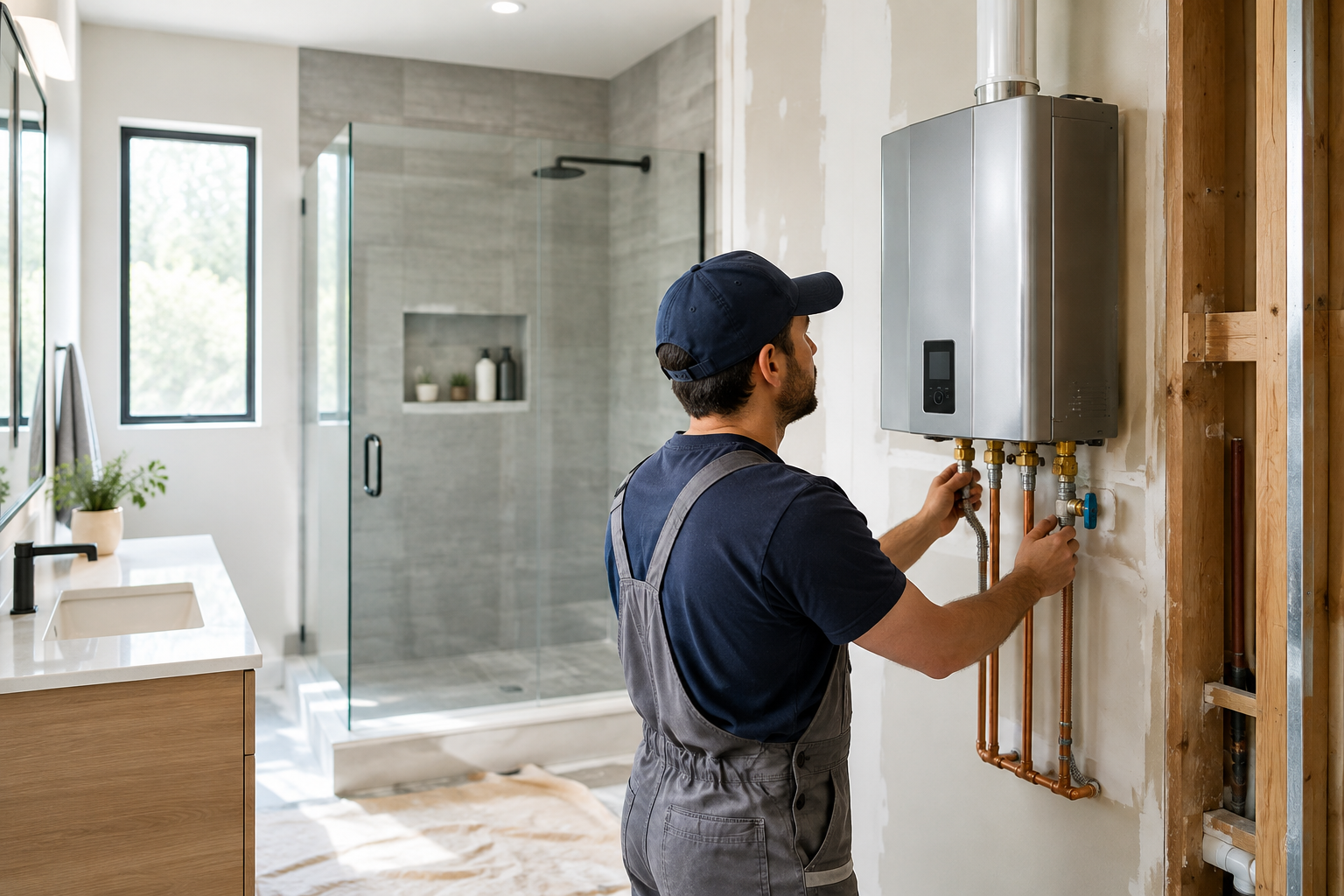
The cheapest time to run a new gas line and vent is while the drywall is already in a dumpster. That is the practical case for upgrading to a tankless water heater during a bathroom reno: the demolition, permits and plumbing inspections you are already paying for cover most of the disruption a standalone swap would create. A gas unit installed as part of an existing remodel typically runs $2,800 to $4,800 in Montgomery and Bucks County, versus $3,500 to $6,000 as a one-off job with its own mobilization, patching and paint.
A tankless water heater needs three things a 50-gallon tank does not: a larger gas supply, a dedicated sealed vent, and a condensate drain on high-efficiency models. Each of those is a wall-and-floor problem, which is exactly what a bathroom gut already solves.
Most older homes in Lansdale, Souderton and Perkasie feed the water heater with a 1/2 inch gas line sized for a 40,000 BTU tank. A whole-home tankless unit draws 150,000 to 199,000 BTU, so that line usually has to grow to 3/4 inch or 1 inch back to the meter.
If your bathroom sits above or beside the mechanical area, the joist bays and chases are open during demo anyway. Running the upgraded line then costs a few hundred dollars in labor instead of a thousand-plus in fishing, cutting and patching later.
Gas tankless units dominate full-home upgrades here because the incoming water is cold. Groundwater in our region runs roughly 45 to 55 degrees in winter, and an electric whole-home unit has to pull 27 to 36 kW to raise that water to 120 degrees at a usable flow rate.
That load means two or three double-pole 40 amp breakers and, in many cases, a 200 amp service. A panel upgrade adds $2,000 to $4,000, which often erases the lower equipment price of electric tankless water heaters.
Electric still makes sense in specific spots: a new powder room over the garage, a basement bath addition far from the mechanical room, or an in-law suite where a 3.5 kW point-of-use unit under the vanity handles one sink. For the main house on natural gas or propane, a condensing gas model is almost always the better long-term call.
A tankless unit is rated in gallons per minute at a given temperature rise, and that second number is where people get burned. A model advertised at 9.8 GPM might only deliver 5.5 GPM when it has to raise 48 degree water to 120 degrees, which is our real winter condition.
Add up what you expect to run at once. A modern rain shower head uses 2.0 to 2.5 GPM, a standard lavatory faucet 1.2 GPM, a dishwasher around 1.5 GPM and a washing machine 2.0 GPM.
Before you search Google for model numbers, read the manufacturer’s temperature-rise chart rather than the headline rating on the box. Most two-and-a-half bath homes land on a unit delivering 6.5 to 8 GPM at a 70 degree rise, and if your remodel adds body sprays or a soaking tub filler, size up or plan for two units in series.
The U.S. Department of Energy reports that for homes using 41 gallons or less of hot water per day, demand water heaters are 24 to 34 percent more energy efficient than storage tanks, dropping to 8 to 14 percent for homes using around 86 gallons daily. That difference comes from eliminating standby loss, the energy a tank burns keeping 50 gallons hot at 3 a.m.
In dollars, that is usually $80 to $200 a year for a typical family of four on natural gas. The stronger financial argument is lifespan: a quality tankless unit lasts 18 to 20 years with descaling, while most tanks fail between years 10 and 13.
Federal tax credits also apply to qualifying high-efficiency models under the 25C program, worth 30 percent of project cost up to $600 for water heaters. Check current eligibility on the ENERGY STAR federal tax credit page before you choose a model, since the qualifying UEF thresholds change.
A 50-gallon tank occupies a cylinder roughly 22 inches wide and 60 inches tall, plus clearance. A wall-hung tankless unit is about the size of a carry-on suitcase, typically 28 by 18 by 11 inches, mounted at eye level.
In a basement, that reclaimed space becomes storage or a path to finishing the room. In homes where the water heater sits in a first-floor utility closet, which is common in Chalfont and North Wales split-levels, we have used the freed-up footprint to widen a hallway linen closet or carve out the extra 14 inches a curbless shower needed.
Interior venting also opens up placement. A condensing unit can vent horizontally through a rim joist with PVC, so it does not have to live under the old chimney chase.
Pennsylvania municipalities follow the International Residential Code and the Uniform Construction Code, so a gas appliance swap with new venting requires a plumbing or mechanical permit and a rough-in inspection. Expect $75 to $250 in municipal fees depending on your township, and schedule the rough inspection before any tile or drywall goes back up.
Sequencing matters more than most homeowners expect. The water heater work belongs in the same phase as rough plumbing and electrical, right after demo, which is the same logic behind handling HVAC changes during a major renovation instead of as a separate project a year later.
Once mechanicals pass, the finish work can run without interruption: waterproofing, then the right grout and tile for a high-moisture bathroom, then trim and paint. Homeowners who are already thinking about efficiency often pair the heater swap with eco-friendly materials elsewhere in the renovation, since the permits and crew are on site either way.
Much of Bucks and Montgomery County sits on limestone and sits in the 8 to 15 grains per gallon hardness range. Scale builds on the heat exchanger faster at tankless operating temperatures, and a neglected unit can lose noticeable flow in four or five years.
Two defenses handle it. Install isolation valves with service ports at the time of installation (they add about $80 to $150 in parts), and flush the exchanger with white vinegar once a year, which takes roughly 45 minutes.
A whole-house softener or a template-assisted crystallization cartridge pushes service intervals out further. Skip both, and you risk voiding the heat exchanger warranty, which most manufacturers condition on documented annual maintenance.
A tankless upgrade is not automatic. If your home is all-electric with a 100 amp panel, if your gas meter is already maxed out by a furnace and range, or if you are selling within two years, the math rarely favors it.
Heat pump water heaters are the other option worth pricing. They cost $1,800 to $3,200 installed, carry higher federal credits, and cut electric water heating costs by 60 to 70 percent, though they need about 750 cubic feet of air space and produce cool exhaust that suits a basement better than a closet.
Most gas tankless water heater installations take one to two working days, or three if the gas line has to be resized back to the meter. Folding it into a bathroom renovation usually adds no calendar time at all, because the work happens during the rough-in phase while tile and fixtures are still on order.
No. A tankless unit gives you endless hot water, not instant, and you may wait 8 to 20 seconds for hot water to reach a distant fixture. Adding a dedicated recirculation pump or a model with a built-in buffer tank cuts that wait to a few seconds for roughly $400 to $900 extra.
Yes, if it delivers at least 6.5 GPM at a 70 degree temperature rise, which covers two showers running simultaneously in winter. Homes with three or more full baths and a soaking tub often need two units manifolded together, which runs an additional $2,000 to $3,000.
It is the brief slug of cool water that arrives seconds after you turn the tap back on, caused by the burner’s ignition delay. Modern condensing models with better modulation reduce it to a two or three second blip, and a small buffer tank eliminates it entirely.
Appraisers rarely assign a line-item value, but a documented high-efficiency water heater upgrade supports the overall condition rating and removes a known buyer objection about a 12-year-old tank. In listings around Lansdale and Doylestown, it reads as a maintenance item already handled rather than a negotiation point.
If your remodel is still in the drawing stage, that is the right moment to price the water heater swap, the gas line and the venting as one scope instead of three separate trips. The team at Wolfpack Home Services can walk the mechanical room with you, size the unit to your actual fixture count, and coordinate the finish trades afterward, from waterproofing to the final paint.

From kitchens to roofs, I manage projects that transform your home.
