Top Decking Materials to Survive Bucks County Weather
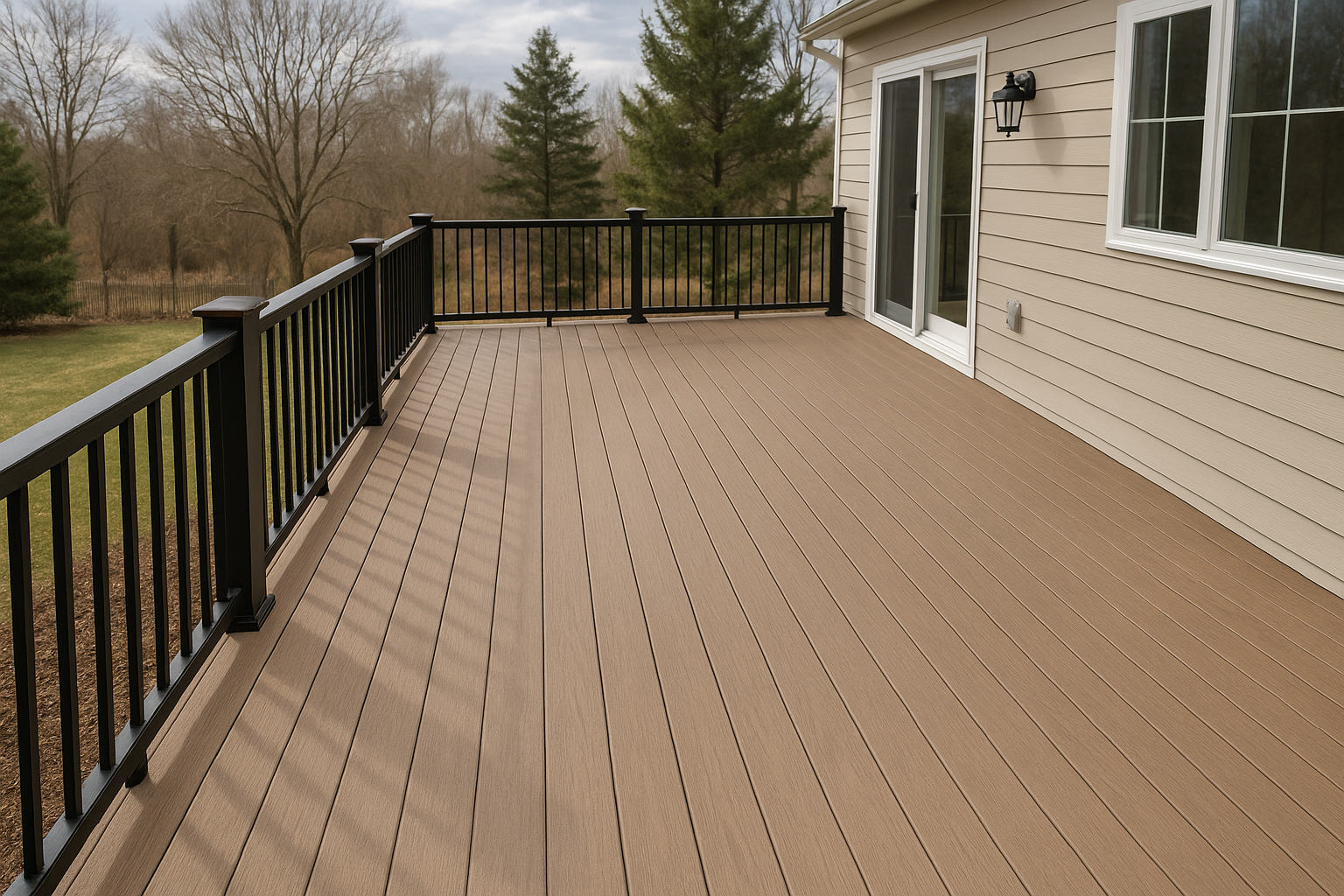
If you want decking materials that survive Bucks County weather, the short answer is capped composite or cellular PVC for most homeowners, with aluminum for exposed second-story decks and pressure treated pine when budget rules the decision. Our winters here cycle above and below freezing dozens of times, and our summers run humid enough to keep shaded framing damp for weeks. That combination, not any single storm, is what actually destroys a deck.
Below is how each material holds up in Doylestown, Newtown, Quakertown and the river towns, plus the structural details that matter more than the brand of board you pick.
Quick Answer: Best Decking by Priority
- Longest life with least work: cellular PVC (30 to 50 years, no staining ever)
- Best all-around value: capped composite (25 to 30 years, strong warranties)
- Best for full sun and heat: aluminum, or light-colored PVC
- Best budget option: pressure treated southern yellow pine (12 to 20 years with real maintenance)
- Best natural wood: ipe or other dense tropical hardwood (30+ years, needs oiling)
- Worst pick for shaded, damp yards: uncapped composite and cedar
Why Bucks County Weather Is Rough on Decking
Southeastern Pennsylvania sits in a punishing middle zone: cold enough for repeated freeze-thaw, wet enough for rot and mold, and hot enough in July to buckle poorly fastened boards. According to NOAA climate normals, this region averages roughly 44 inches of precipitation a year spread across all four seasons, so decking almost never gets a long dry rest.
Four local stressors do the real damage:
- Freeze-thaw cycling: water wicks into board ends and screw holes, freezes, expands about 9 percent, and slowly splits the fiber. Our area sees 40 to 50 crossings of 32°F in a typical winter.
- Summer humidity and shade: yards with mature oaks and maples hold moisture at the joist line, which feeds rot and slick algae growth.
- UV exposure: south and west-facing decks in open developments fade fastest, and dark boards can hit 150°F surface temperature on an August afternoon.
- Snow and ice management: Pennsylvania’s code uses a 30 psf ground snow load in Bucks County, and homeowners often add calcium chloride ice melt that corrodes plain steel fasteners.
Material behavior in the cold matters too. Everything on a deck expands and contracts at different rates, which is the same principle we cover in our breakdown of how exterior materials behave in low temperatures.
Capped Composite Decking
Capped composite blends wood flour with polyethylene or polypropylene, then wraps the board in a polymer shell that blocks moisture and stains. That cap is the whole story: first-generation uncapped composite from the early 2000s absorbed water on the top surface and grew mold, which is why so many 20-year-old boards around Perkasie look chalky and spotted.
Modern capped lines from Trex, TimberTech, Fiberon and Deckorators carry 25 to 50 year limited warranties and typically last 25 to 30 years in our climate. Expect $45 to $75 per square foot installed in 2026 for a standard ground-level build, more if you add hidden fasteners, picture framing or lighting.
Weak points worth knowing: composite gets hot in full sun, scratches under dog claws, and needs proper joist spacing (12 to 16 inches on center, depending on the product) to avoid sag. For a deeper side-by-side, read our comparison of composite vs. wood decking in humidity and snow.
Cellular PVC Decking
PVC decking contains no organic material at all, so there is nothing for mold or rot to feed on. In shaded, poorly drained yards, and around pools where splash-out is constant, this is the most weather-resistant decking material you can buy without going to metal.
Cellular PVC runs $55 to $90 per square foot installed, weighs about 30 percent less than composite, and commonly carries 30 to 50 year warranties. The trade-offs are a slightly more plastic look up close and a higher expansion rate lengthwise, which means end gaps and fastener spacing have to follow the manufacturer’s chart rather than a carpenter’s habit.
Related reading: Masonry Restoration: Preserving Bucks County’s Fieldstone Charm.
For a closer look at this topic, see our guide: The Pros and Cons of Adding a Sunroom in Bucks County.
When you compare products, look for compliance with ASTM D7032, the standard test method for plastic and composite decking performance. It covers span rating, slip resistance and flame spread, and it separates serious manufacturers from bargain imports.
Aluminum Decking
Aluminum is the quiet winner for exposed second-story decks and rooftop platforms. Powder-coated extruded planks interlock to shed water, will not rot, warp, splinter or burn, and stay cooler than dark composite because the metal dissipates heat quickly.
Cost lands around $60 to $100 per square foot installed, and the look is more contemporary than most Bucks County farmhouses want. Where it shines: a waterproof aluminum deck over a walkout basement or covered porch, which pairs well with an integrated roof structure. If your project includes a roof over the deck, we handle that under our roofing services across Montgomery County and Bucks County.
Pressure Treated Pine
Pressure treated southern yellow pine still accounts for the majority of decks built here, and there is nothing wrong with that if you accept the upkeep. Treatment chemicals resist decay fungi and termites, but they do not stop the water absorption that causes checking, cupping and end splits.
Budget $30 to $45 per square foot installed, then plan on cleaning and re-sealing every two to three years. Two habits stretch a treated deck from 12 years to 20:
- Let new boards dry 60 to 90 days before the first sealer coat, then use a penetrating oil or oil-modified stain rather than a film-forming paint.
- Wash the surface each spring and clear leaf litter from board gaps, which is the same logic behind an annual April power wash.
Cedar, Redwood and Tropical Hardwood
Western red cedar looks beautiful and stays cool underfoot, but it is soft, and in a damp shaded Bucks County yard it can show rot at the fasteners inside 10 to 15 years. Redwood is rarely cost-effective this far east once freight is added.
Ipe, cumaru and garapa are a different category. These hardwoods are so dense they sink in water, resist insects naturally, and last 30 years or more, though they need annual oiling to keep the color and they demand pre-drilled stainless fasteners. Installed pricing generally falls between $50 and $80 per square foot.
Match the Material to Your Exposure, Not Just Your Budget
This is where most articles stop short. The best decking material for your neighbor two streets over may be wrong for your lot, because sun angle and drainage vary block to block.
- Full south or west sun, no trees: choose light-colored PVC or aluminum, and skip dark composite unless you are always in shoes.
- Heavy shade, north-facing, slow-draining soil: PVC or capped composite with a well-ventilated frame; avoid cedar entirely.
- Under mature trees with tannin drop: capped composite cleans up far easier than any stained wood.
- Pool or hot tub surround: PVC, plus a slip-resistance rating you actually verify.
- Low, at-grade patio space: consider skipping decking and going to stamped concrete, which handles snow removal and freeze-thaw well when properly based and sealed.
The Substructure Outlives or Kills the Deck
A 50-year PVC surface on a 15-year frame is wasted money. Most deck failures we open up in Bucks County start at the ledger board or the joist tops, not on the walking surface.
- Ledger flashing: stainless or coated metal flashing plus proper through-bolts, never lag screws into sheathing alone.
- Joist tape: self-adhesive butyl tape over joist tops blocks water sitting in screw holes, which is the single cheapest longevity upgrade available.
- Stainless or triple-coated fasteners: ACQ-treated lumber and ice melt both corrode plain steel fast.
- Footings below frost: Bucks County frost depth is generally taken at 36 inches, and shallow piers heave.
- Steel framing: galvanized steel joists add roughly 15 to 25 percent to framing cost and remove wood rot from the equation completely.
Planning a smaller footprint? Our post on design ideas for compact backyard decks shows how material choice changes when square footage is limited.
Frequently Asked Questions
What is the most weather-resistant decking material?
Cellular PVC and aluminum are the most weather-resistant decking options, with expected service lives of 30 to 50 years and no organic content to rot. Capped composite is a close third at 25 to 30 years, and it usually wins on appearance and price for residential projects in our area.
What is the 3/4/5 rule for decks?
The 3/4/5 rule is a squaring check: measure 3 feet along one side, 4 feet along the adjoining side, and if the diagonal between those marks equals exactly 5 feet, the corner is a true 90 degrees. It comes from the Pythagorean theorem and scales up (6/8/10 or 9/12/15) for larger frames, which is how builders keep long deck rims straight.
How much would a 20×20 Trex deck cost?
A 400 square foot Trex deck typically runs $18,000 to $30,000 installed in 2026, depending on the product line, height off grade, railing style and stair count. Materials alone usually land between $6,000 and $11,000, so labor, framing, footings and permits make up more than half the total on most jobs.
Which deck material is least likely to rot?
Aluminum and cellular PVC cannot rot at all, because neither contains wood fiber. Among woods, dense tropical hardwoods like ipe resist decay best, while pressure treated pine resists fungal decay chemically but still absorbs water and can check or split over 10 to 15 winters.
Ready to Build a Deck That Handles Our Winters?
Tell us your lot conditions, sun exposure and budget, and we will spec the decking and framing combination that makes sense for your property. Wolfpack Home Services builds and rebuilds decks throughout Bucks and Montgomery counties, and you can read what neighbors say on our reviews page before you call.