
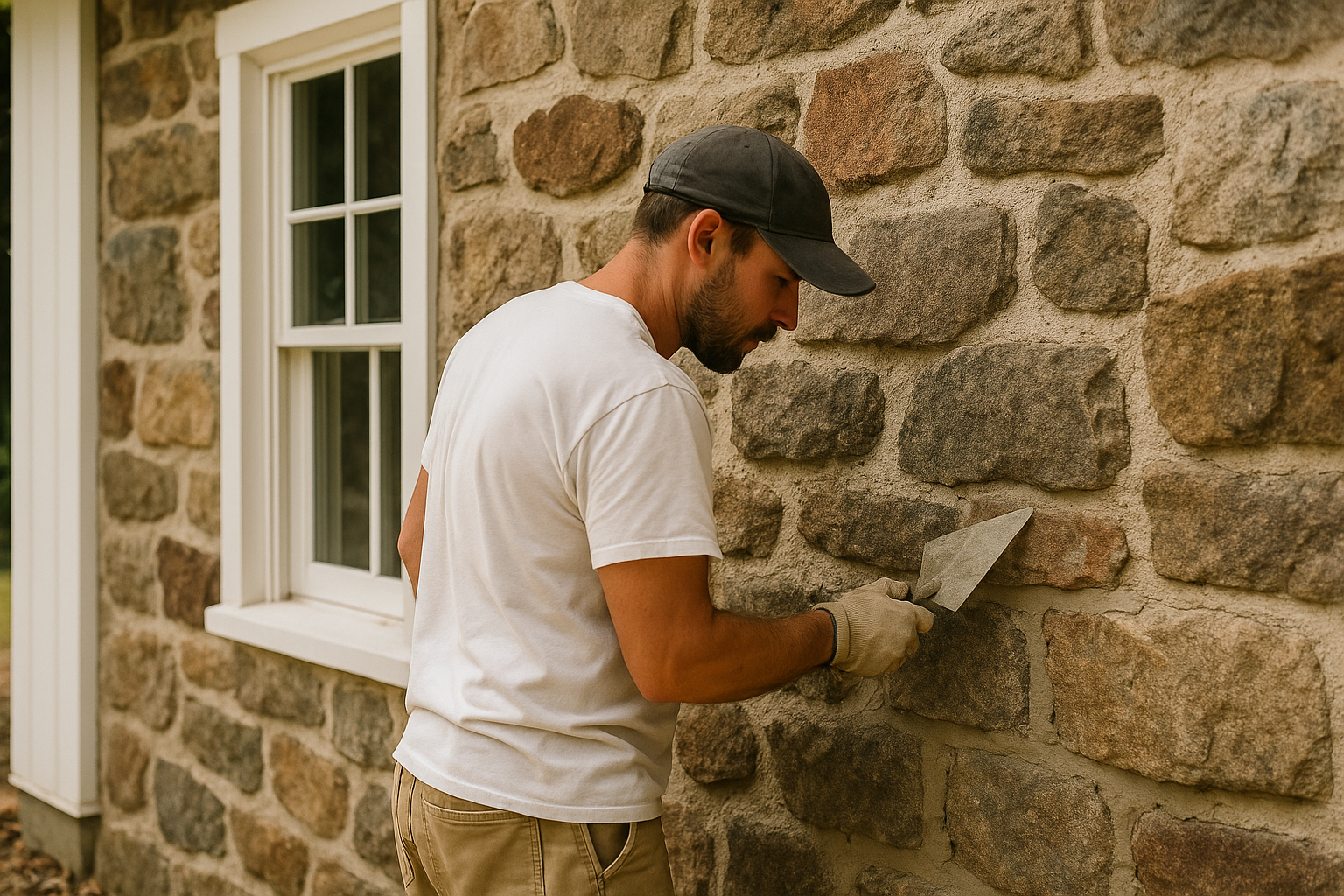
Masonry Restoration: Preserving Bucks County’s Fieldstone Charm
Masonry restoration on a Bucks County fieldstone home is less about making old walls look new and more about keeping 200-year-old stone from being destroyed by the wrong repair. The single biggest threat to fieldstone charm in this county is not weather or age, it’s hard Portland cement mortar applied by well-meaning crews. Understanding that one distinction will save you tens of thousands of dollars over the life of the house.
This guide covers how to read your walls, what proper repointing involves, realistic costs in Bucks and upper Montgomery County, and the cleaning and sealing mistakes that quietly wreck stone.
What Makes Bucks County Fieldstone Different
The stone in local walls came out of local ground, which is why a farmhouse in Solebury looks different from one in Quakertown. Farmers cleared fields, stacked what they pulled up, and built with it. That geology shapes how the masonry behaves today.
- Argillite and red shale dominate central Bucks around Doylestown, Buckingham and Point Pleasant. Argillite is dense and durable; shale delaminates in flat sheets when it stays wet.
- Wissahickon schist and gneiss appear in the lower county and toward Montgomery, often with visible mica flecks that catch light.
- Limestone shows up in the Durham and Springfield Township areas, and it is more vulnerable to acid rain and harsh chemical cleaners.
- Mixed rubble walls, the most common type, combine several stone types with brick infill at openings and chimneys.
Most pre-1900 walls in the region are two wythes of stone with a rubble core, 18 to 24 inches thick. They were never waterproof by design. They were built to absorb moisture and release it through soft mortar joints, which is exactly why modern sealed-up repairs cause damage.
The Portland Cement Problem Nobody Warns You About
Here is the gap most masonry pages skip. When a mason repoints historic fieldstone with a standard Portland cement mix, the new mortar cures far harder than the surrounding stone. Compressive strength for modern cement mortar can exceed 2,500 psi, while original lime mortars typically ran between 100 and 400 psi.
Because water still enters the wall, it now has nowhere soft to exit. It migrates into the stone face instead, freezes, and spalls the surface off. On red shale and limestone you can see this within five to eight winters: sugary crumbling stone faces sitting next to perfectly intact gray mortar joints.
The federal standard on this is unambiguous. The National Park Service Preservation Brief on repointing states that new mortar should be softer and more vapor permeable than the masonry units, never harder. You can read the full technical guidance in the NPS Preservation Briefs series, which is the reference serious restoration masons work from.
Natural Hydraulic Lime: The Correct Alternative
Natural hydraulic lime (NHL) mortar is the material of choice for historic masonry restoration in southeastern Pennsylvania. It is sold in graded strengths, and the grade matters:
- NHL 2 for very soft interior work and delicate limestone.
- NHL 3.5 for most Bucks County fieldstone walls, chimneys and exposed elevations.
- NHL 5 for below-grade work, water tables and heavily exposed foundations.
NHL sets slowly, stays flexible, and lets moisture escape through the joint instead of the stone. It also self-heals hairline cracks over time as free lime recrystallizes, something no cement mix does. Expect a proper NHL 3.5 mix to cost roughly 30 to 50 percent more in materials than bagged Type N, which is nothing against the cost of replacing spalled stone.
How to Read Your Own Walls Before Calling Anyone
Walk the perimeter on a dry day with a screwdriver and a flashlight. You are looking for patterns, not individual flaws.
- Probe the joints. If a screwdriver tip pushes in more than a quarter inch with light pressure, that section needs repointing. Sand pouring out is normal for depleted lime mortar.
- Look for gray patch jobs. Hard cement patches from the 1960s through the 1990s are the most common source of active stone damage.
- Check the bottom three feet. Rising damp, white efflorescence and flaking stone at grade usually point to soil built up against the wall or a failed grade slope.
- Follow the water. Trace stains upward. Nine times out of ten, stone deterioration sits directly below a failed gutter, a cracked chimney crown, or a roof edge that has been leaking quietly for years.
- Note bulges and step cracks. Diagonal cracking that widens over a season is structural and deserves a licensed engineer, not just a mason.
Because so much stone damage originates above the wall, we often find that the real fix starts at the roofline. Homeowners in central Bucks handling both at once frequently pair repointing with roofing services in Doylestown, PA so the water source is corrected before the mortar work cures.
What Proper Masonry Restoration Actually Involves
A legitimate repointing scope on a fieldstone wall follows a predictable sequence, and it is slower than most people expect.
For a closer look at this topic, see our guide: Stamped Concrete Patterns That Look Exactly Like Natural Stone.
We cover this topic in more depth in Enhancing Curb Appeal with Custom Exterior Masonry.
Related reading: Preparing Your Bucks County Roof for Spring Showers.
- Mortar analysis. A sample of original mortar is tested or visually matched for aggregate color, size and binder ratio. Good masons collect local sand so the finished joint blends with the rest of the house.
- Hand raking of joints. Deteriorated mortar is removed to a depth of two to two and a half times the joint width, by hand chisel or small grinder used carefully. Aggressive angle grinding on rubble stone widens joints permanently and is a red flag.
- Pre-wetting. Stone and joint cavity are dampened so the new lime mortar does not lose water too fast.
- Packing in lifts. Mortar goes in layers of roughly 3/8 inch, each allowed to stiffen before the next. Filling a deep joint in one pass leads to shrinkage cracks.
- Tooling and curing. Joints are struck to match the original profile, then misted and shaded for three to seven days. Lime mortar cures by carbonation, not evaporation, so this step is not optional.
Weather windows in Pennsylvania run roughly from mid-April through late October. Lime work should not be done when overnight temperatures dip below 40 degrees Fahrenheit, because incomplete carbonation leaves weak, crumbly joints by spring.
Cleaning and Sealing: Where Good Intentions Go Wrong
Two things damage more historic stone in this county than neglect ever has: high-pressure washing and film-forming sealers.
Fieldstone should be cleaned at low pressure, generally under 500 psi, with a gentle detergent and dwell time doing the work instead of force. Pressure above 1,200 psi drives water deep into the rubble core, blows out lime joints, and etches soft stone faces. If you want organic growth off a stone wall, walkway or patio, hire a crew that understands the difference between soft washing and blasting, like the teams handling power washing in Quakertown and power washing in Harleysville.
Silicone and acrylic “waterproofing” sealers are worse. They trap moisture behind a vapor barrier, and the water exits by pushing the stone face off. If a wall genuinely needs treatment, a breathable mineral or silicate consolidant is the only sensible category, and even then only after the mortar and drainage issues are fixed.
Costs and Timelines in Bucks County
Pricing varies with access, height and how much prior cement work has to be cut out, but these ranges hold for most 2026 projects in the Doylestown, Newtown, Perkasie and New Hope corridors:
- Spot repointing (under 200 square feet, ground level): $1,800 to $4,500.
- Full elevation repointing with lime mortar: $28 to $55 per square foot, higher on staging above 20 feet.
- Chimney rebuild above the roofline: $4,500 to $12,000 depending on flue count and stone salvage.
- Stone foundation and water table repair: $6,000 to $20,000, often bundled with grading and downspout extensions.
- Mortar sample analysis: $150 to $400 through a testing lab.
A typical two-elevation farmhouse repointing runs three to six weeks of field time. Done correctly with natural hydraulic lime, the repair should last 50 to 100 years, versus 10 to 20 for a cement repoint that damages stone along the way.
Historic Districts, Permits and Local Review
If your property sits in a certified historic district such as Doylestown Borough, New Hope, Newtown Borough or portions of Bristol, exterior masonry work may require review by a historical architectural review board before you start. Mortar color, joint profile and cleaning method are all fair game for comment.
Homeowners pursuing state or federal preservation tax credits have stricter standards to meet, and the Pennsylvania Historical and Museum Commission publishes the guidance those programs follow. Even outside a district, documenting your mortar match protects resale value on a house whose main asset is its original stonework.
Choosing a Mason: What to Ask
Searching for masonry work near you turns up plenty of general contractors who treat stone like block. Ask direct questions instead:
- What lime binder and grade will you use, and why that grade for my stone?
- How will joints be cut out, and how deep?
- Can I see two fieldstone repointing jobs you completed five or more years ago?
- Will you build a sample panel of two square feet for approval before full production?
- How will you protect the cure during hot or cold spells?
Verified customer feedback helps too. Reading through our reviews gives a sense of how a crew communicates once staging is up and the surprises appear, which they usually do on 200-year-old walls.
Restoration also tends to snowball into related exterior work. Once the stone is stable, many owners move on to hardscaping services in Souderton for matching stone walls and walkways, or take on projects like adding a sunroom in Bucks County and choosing decking materials built for Bucks County weather. Sequencing matters: masonry and roof first, attached structures second.
Frequently Asked Questions
How often does fieldstone need repointing?
Properly executed lime repointing lasts 50 to 100 years, while cement-based repointing typically fails in 10 to 20. Most Bucks County farmhouses need partial attention every generation, usually on the weather elevation facing west or northwest.
Can I repoint stone myself?
Small spot repairs under about 10 square feet at ground level are realistic for a patient DIYer using pre-blended NHL 3.5 mortar. Anything involving ladders, chimneys, structural cracks or removal of old cement patches belongs with a mason, since joint prep causes more damage than bad mortar does.
Is lime mortar strong enough for a load-bearing wall?
Yes. Natural hydraulic lime at 350 to 750 psi comfortably exceeds the loads in a 20-inch rubble stone wall, and thousands of local homes have stood on lime for two centuries. Strength in historic masonry comes from wall mass and stone bearing, not mortar hardness.
What does efflorescence on my stone wall mean?
White powdery deposits mean water is moving through the wall and depositing dissolved salts, and it almost always signals a moisture source rather than a cosmetic issue. Check gutters, grade slope and interior humidity before treating the surface; brushing it off dry is safer than washing it in.
Should I paint or parge a stone foundation?
Avoid modern elastomeric paint and cement parging on historic stone, since both trap moisture and accelerate spalling. A breathable lime wash or lime parge coat is the appropriate option when you want a uniform look on a foundation or basement wall.
Get Your Fieldstone Assessed Before Another Winter
Freeze-thaw cycles do their worst work between December and March, so an assessment now leaves time to schedule lime mortar work inside the spring and summer curing window. Contact Wolfpack Home Services to walk your walls, identify the water source behind the damage, and price the repair honestly against what your stone actually needs.