
August 26, 2026

The essential questions to ask before hiring a general contractor in In, PA are not the same as the ones you would ask in New Jersey or Delaware, because Pennsylvania regulates home improvement work through a registration system rather than a statewide contractor license. Knowing that difference changes what you ask, what paperwork you request, and which answers should make you walk away. Below are the questions we would want a homeowner to ask us, plus the PA-specific legal details most national checklists skip.
Pennsylvania does not issue a general contractor license at the state level. Instead, anyone doing more than $5,000 per year in home improvement work must register with the Office of Attorney General under the Home Improvement Consumer Protection Act (HICPA) and display a PA Home Improvement Contractor number, usually written as PA######.
Trade licenses (electrical, plumbing, HVAC) and building permits are handled locally by your township or borough, so requirements in Lansdale differ slightly from those in Doylestown or Bensalem. That means a contractor can be perfectly legitimate statewide and still be unfamiliar with your municipality’s inspection process.
You can verify any registration number for free through the Pennsylvania Attorney General’s HICPA resources before you sign anything. It takes about two minutes and it is the single highest-value thing on this list.
A registered contractor will give you the number without hesitation, and it should also appear on estimates, contracts and advertising. If someone says registration “isn’t required for this type of job,” ask them to cite the exemption in writing.
HICPA requires at least $50,000 in personal injury liability and $50,000 in property damage coverage, though most established general contractors in Bucks and Montgomery counties carry $1 million per occurrence. Ask for the certificate to come from the insurance agency rather than from the contractor’s inbox, and confirm workers’ compensation coverage for every person on your property.
Find out whether the crew is made up of employees or subcontractors, who the daily point of contact is, and how many other jobs that person is running at the same time. A general contractor juggling six active projects is common; one juggling sixteen usually is not.
Specificity matters more than volume. A roofer with 400 tear-offs behind them may still be the wrong fit for a slate repair on an 1890s farmhouse, and a crew that pours driveways daily is not automatically the right choice for a decorative patio.
Ask for addresses, photos and the approximate contract value of each comparable job. Then ask what went wrong on one of them, because every real project has a story.
The older reference is the useful one. It tells you how the work held up through several Pennsylvania freeze-thaw cycles and whether the contractor answered the phone when a call-back was needed.
Read online reviews with the same lens, looking for patterns in communication and follow-through rather than star counts. Our own customer reviews are a good example of what to read for: names, project types and specifics.
In Pennsylvania, any home improvement contract over $500 must be in writing and include specific items. Before signing, confirm the document contains all of the following:
A contract missing these elements may be unenforceable against you, but that is a legal fight you would rather avoid entirely.
Related reading: How to Choose the Right General Contractor for a Commercial Project.
Under HICPA, a contractor generally cannot collect more than one third of the contract price up front, plus the actual cost of any special-order materials. On a $40,000 kitchen, that means roughly $13,333 down, not half.
Tie the remaining payments to milestones you can see: framing complete, rough inspection passed, drywall finished, punch list closed. Hold a final payment of 5 to 10 percent until everything on the punch list is done.
Ask whether changes are billed at cost plus a fixed percentage (10 to 20 percent is typical) or as a flat quoted number, and require every change in writing before work proceeds. Verbal change orders are the leading cause of end-of-project disputes we hear about from homeowners.
Exclusions tell you more than inclusions. Common ones on Pennsylvania projects include dumpster fees, permit fees, asbestos or lead abatement in pre-1978 homes, rotted sheathing discovered during a tear-off, and electrical panel upgrades needed to meet code.
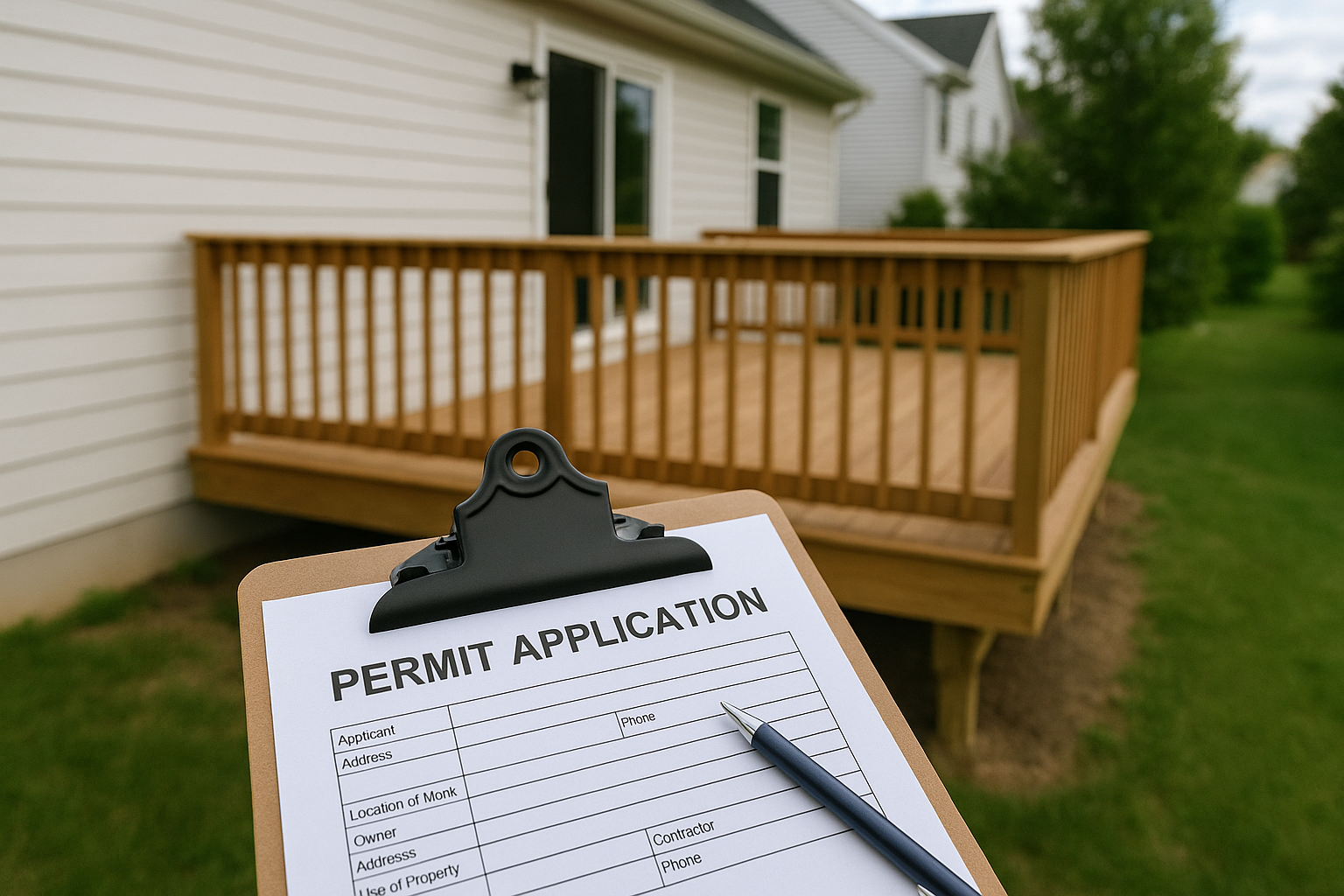
The contractor should pull permits in their own name. If they ask you to pull the permit as the homeowner, that shifts code liability onto you, and it is a common workaround for contractors who cannot register with the municipality.
Permit rules vary a lot locally, as we covered in our breakdown of deck permits in Perkasie. Expect permit review to take one to four weeks in most Bucks and Montgomery County townships.
Ask for a schedule with phases, not a single end date, and ask what the contractor does when materials are backordered or an inspector is booked out ten days. A good answer includes a communication rhythm: a weekly update call, a shared schedule, or a project management app.
These are two different things. Manufacturer warranties on shingles or siding can run 25 to 50 years, while the contractor’s workmanship warranty is what protects you if the installation was the problem, and one to five years is the typical range in our market.
Here is the gap in most checklists: ask the contractor what could go wrong on this specific house. A contractor who has walked your basement, checked the grade around your foundation, or pulled up a shingle already has a list.
An estimator who quotes a finished basement without mentioning egress windows, sump discharge or moisture testing has not looked hard enough. Our guide to finishing a basement in Bensalem walks through exactly which of those items drive the budget.
The same applies to exterior work. Before any repaint or siding job, the surface needs to be clean, which is why we treat a full-house power wash in April as prep work rather than an upsell.
Collect three written proposals and put them side by side on the same line items: materials and brand, square footage or linear footage, labor, permits, disposal, and warranty length. The lowest number is often the one missing a scope item, not the one with better pricing.
If one bid is 30 percent below the others, ask specifically what that contractor excluded. The Federal Trade Commission’s guidance on hiring a contractor makes the same point about unusually low bids and large cash deposits.
Also weigh whether the company handles the whole scope. A general contractor who can coordinate roofing work across Montgomery County, interior and exterior painting in Lansdale and stamped concrete patios under one contract removes the finger-pointing that happens between separate trades.
The clearest red flags are a missing PA HIC registration number, a demand for more than one third down, and pressure to decide before the three-day cancellation window is explained. Others include cash-only pricing, no written contract, a P.O. box instead of a business address, door-to-door solicitation after a storm, and refusal to provide a certificate of insurance from the carrier.
At minimum, ask these five: what is your PA registration number, can I see current liability and workers’ compensation certificates, have you done three comparable projects recently, what is the written payment schedule, and who pulls the permits. Follow those with questions about change order pricing, workmanship warranty length, and the daily point of contact on your job.
Avoid naming your absolute maximum budget in the first conversation, since it anchors the bid to your ceiling instead of the scope. Also avoid saying you have not gotten other quotes, that you are in a rush, or that you will pay in cash to avoid paperwork, which removes the written record you would need in a dispute.
Beyond credentials, homeowners typically ask about crew size, subcontractor use, daily work hours, site cleanup, material storage and how the punch list gets closed out. Construction professionals interviewing for staff positions get similar operational questions about scheduling software, safety records and cost tracking, since both conversations test the same thing: does this person run organized projects?
We are happy to hand over our PA registration number, insurance certificates and recent local references before you ask. Contact Wolfpack Home Services for a written, line-itemed estimate on your roofing, siding, painting, concrete or remodeling project in Bucks and Montgomery counties.
From kitchens to roofs, I manage projects that transform your home.
