
October 16, 2026

Preparing your Bucks County roof for spring showers is mostly about catching small problems in March before April rain turns them into ceiling stains. Our winters here run through a punishing freeze-thaw cycle, and the damage it leaves behind rarely announces itself until water is already inside. This guide walks through what to inspect, what it typically costs to fix, and where homeowners usually get it wrong.
Bucks County averages roughly 45 to 48 inches of precipitation a year, and a good share of it arrives between March and June in long, soaking storms rather than quick downpours. The National Weather Service office in Mount Holly tracks these systems regularly parking over the Delaware Valley for 12 to 36 hours at a stretch.
That sustained soaking is the real test. A shingle that lifted during January’s ice, or a nail that backed out a quarter inch during a 40-degree temperature swing, will hold up fine against a ten-minute shower and fail completely against a day and a half of steady rain driven by a northeast wind.
Homes in the older parts of the county, Doylestown, Newtown, Yardley, Perkasie, often carry a mix of roof ages: a 1990s addition over a 1960s ranch section, or new shingles over original decking. Those transitions are where spring leaks tend to start.
Most homeowners walk the perimeter with binoculars and call it an inspection. The faster read on a roof’s condition is from underneath, on a bright afternoon with the attic lights off. Give your eyes a minute to adjust and look for daylight coming through the sheathing at nail holes, ridge lines and around vent pipes.
While you are up there, check for these five signs:
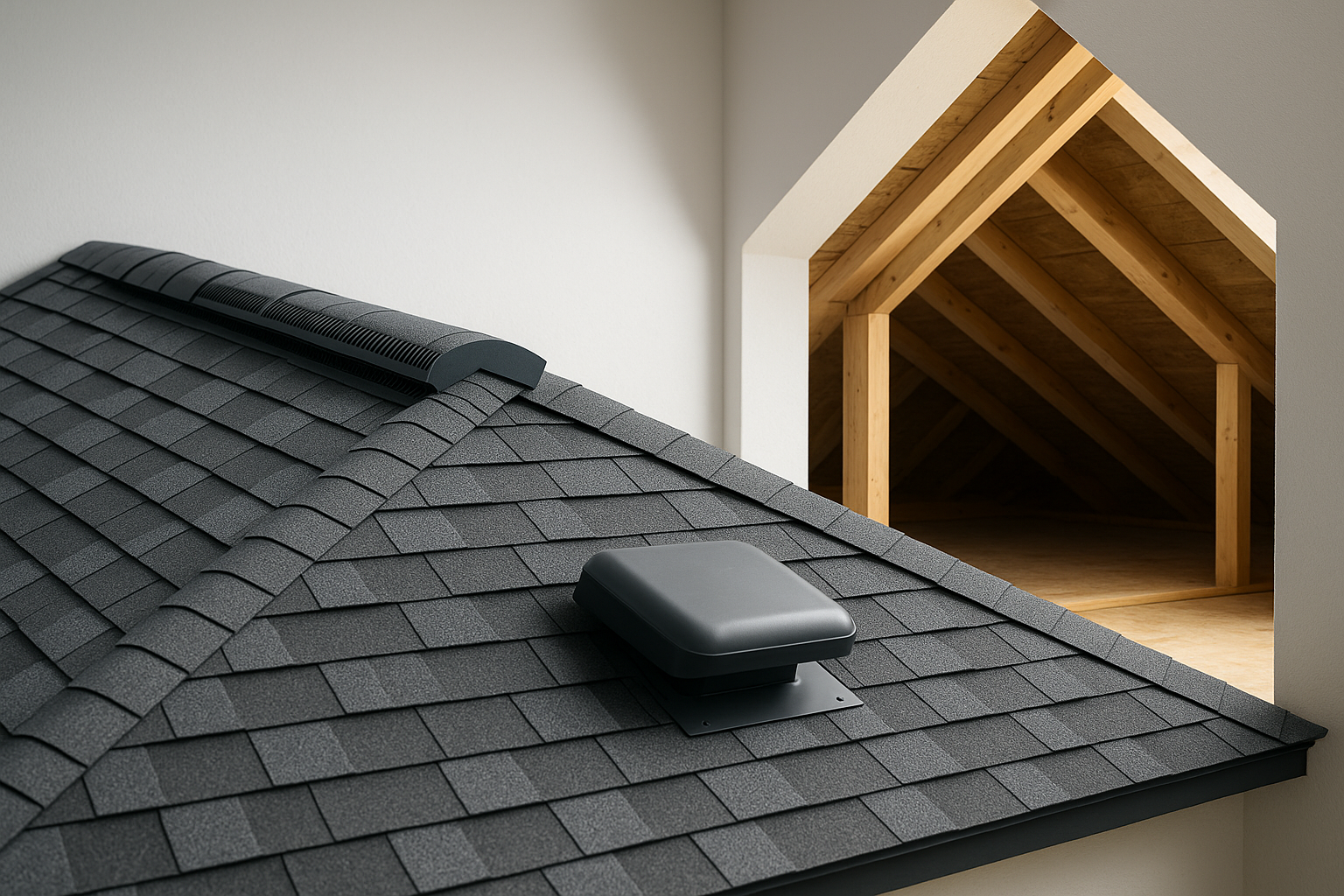
Ventilation matters more than people expect. A poorly vented attic runs hot and damp, which cooks shingles from below and shortens their service life by several years. Balanced intake at the soffits and exhaust at the ridge is the standard target, and it costs far less to correct now than after the decking softens.
Once you have read the attic, walk the full perimeter of the house. Stay off the roof itself unless you have proper fall protection; the majority of homeowner roof injuries happen on wet or frosted surfaces in exactly this season.
Clean gutters are the cheapest insurance against water damage you can buy. A standard 5-inch K-style gutter handles a lot of volume until it holds two inches of decomposed oak leaves, at which point rain sheets over the front edge and lands against your foundation.
Flush every downspout with a hose and watch where the water actually goes. Extensions should discharge at least four to six feet from the foundation, and on the sloped lots common around Buckingham and Solebury, farther than that.
We cover this topic in more depth in Common Surprises When Remodeling an 18th-Century Bucks County Farmhouse.
For a closer look at this topic, see our guide: Why You Shouldn't DIY Your Basement Finishing Project.
For a closer look at this topic, see our guide: Commercial Roofing Maintenance Tips for Bucks County Businesses.
For a closer look at this topic, see our guide: Walk-In Showers vs. Tubs: What Buyers Want in Richboro.
Also check that gutters are still pitched correctly toward the outlets. Ice loading over the winter frequently pulls hangers loose, and a gutter that holds standing water will sag, rot the fascia behind it, and eventually pull away entirely. Rehanging a section runs far less than replacing rotted fascia and soffit later.
Early spring is the best window to trim limbs back, because you can still see the branch structure clearly. Aim for at least six to ten feet of clearance between overhanging limbs and the roof surface.
Branches that scrape shingles in a storm strip granules quickly, and limbs hanging directly overhead keep a section of roof permanently shaded and damp, which is where moss and the black algae streaking you see all over Bucks and Montgomery County roofs takes hold. If your roof already has that dark streaking, a soft wash by a company that understands roofing surfaces is a better option than pressure washing, which strips granules and voids most shingle warranties.
Here is the step nearly every spring roof article skips: take dated photos now, before storm season. Shoot each elevation of the house, the gutters, and any existing wear.
When a genuine wind or hail event hits in May and you file a claim, the difference between an approved and denied claim often comes down to proving the roof was intact beforehand. Most Pennsylvania homeowners policies also carry claim reporting deadlines, commonly one year from the date of loss, so a photo record with timestamps is genuinely useful. Keep receipts for any maintenance work in the same folder.
Budgeting is easier when you know the ranges. In the Bucks and Montgomery County market for 2026, homeowners generally see:
If the numbers are out of reach, Pennsylvania has funded repair assistance at various points through the Whole-Home Repairs Program administered by the state Department of Community and Economic Development and delivered locally by county agencies. Funding availability changes year to year, so contact the Bucks County Housing office directly rather than assuming a program is open or closed. Some county weatherization programs also cover roof work when it is needed before insulation can be installed.
Call a professional if you find active staining on interior ceilings, more than a handful of missing shingles, any soft spot in the decking, or flashing that has been repeatedly patched with sealant. Those conditions do not improve on their own once the rain starts.
A flat or low-slope section, common on older additions and porch roofs, is a separate conversation. Those surfaces often respond well to a professional roof coating that seals seams and adds years of service without a full tear-off. Homeowners in the northern part of the county can start with our Perkasie roofing team, and we cover the rest of the region through our Montgomery County roofing services.
Spring is also when people start planning outdoor projects, and roof condition affects those decisions. If you are weighing adding a sunroom or replacing a deck, it is worth reading up on decking materials that hold up to local weather before you tie new construction into an aging roof.
The 25% rule states that if more than 25% of a roof section is damaged or repaired within any 12-month period, the entire section must be brought up to current building code rather than patched. It comes from the International Residential Code, which Pennsylvania’s Uniform Construction Code adopts, and it is why insurers and inspectors sometimes require a full replacement instead of a repair.
Standard #15 and #30 asphalt felt should not stay exposed longer than about 7 to 14 days before it wrinkles, tears at the fasteners and loses its water resistance. Synthetic underlayments are rated much longer, commonly 90 to 180 days depending on the manufacturer, which is why most crews use them when a project may pause for weather.
Yes, an injured worker can potentially sue a homeowner, but in practice a properly insured contractor’s workers’ compensation coverage handles the claim first. Your exposure rises sharply when you hire uninsured labor or a handyman without workers’ comp, so request a certificate of insurance naming your address before any work begins. This is general information, not legal advice.
For rafters spaced 16 inches on center with asphalt shingles, 1/2-inch (nominally 15/32) plywood or OSB meets code in most cases, while 24-inch spacing or heavier materials like slate and tile call for 5/8-inch or 3/4-inch sheathing. Many local re-deck jobs use 5/8-inch because it resists sagging between rafters and holds fasteners better on older framing.
If your attic check turned up daylight, staining or a soft spot, Wolfpack Home Services can inspect the roof and give you a written scope with real numbers before the first heavy storm. See what local homeowners say about our work, then get in touch to schedule a visit.
Need expert remodeling or construction in Bucks County? Let’s make it happen!
