September 19, 2026
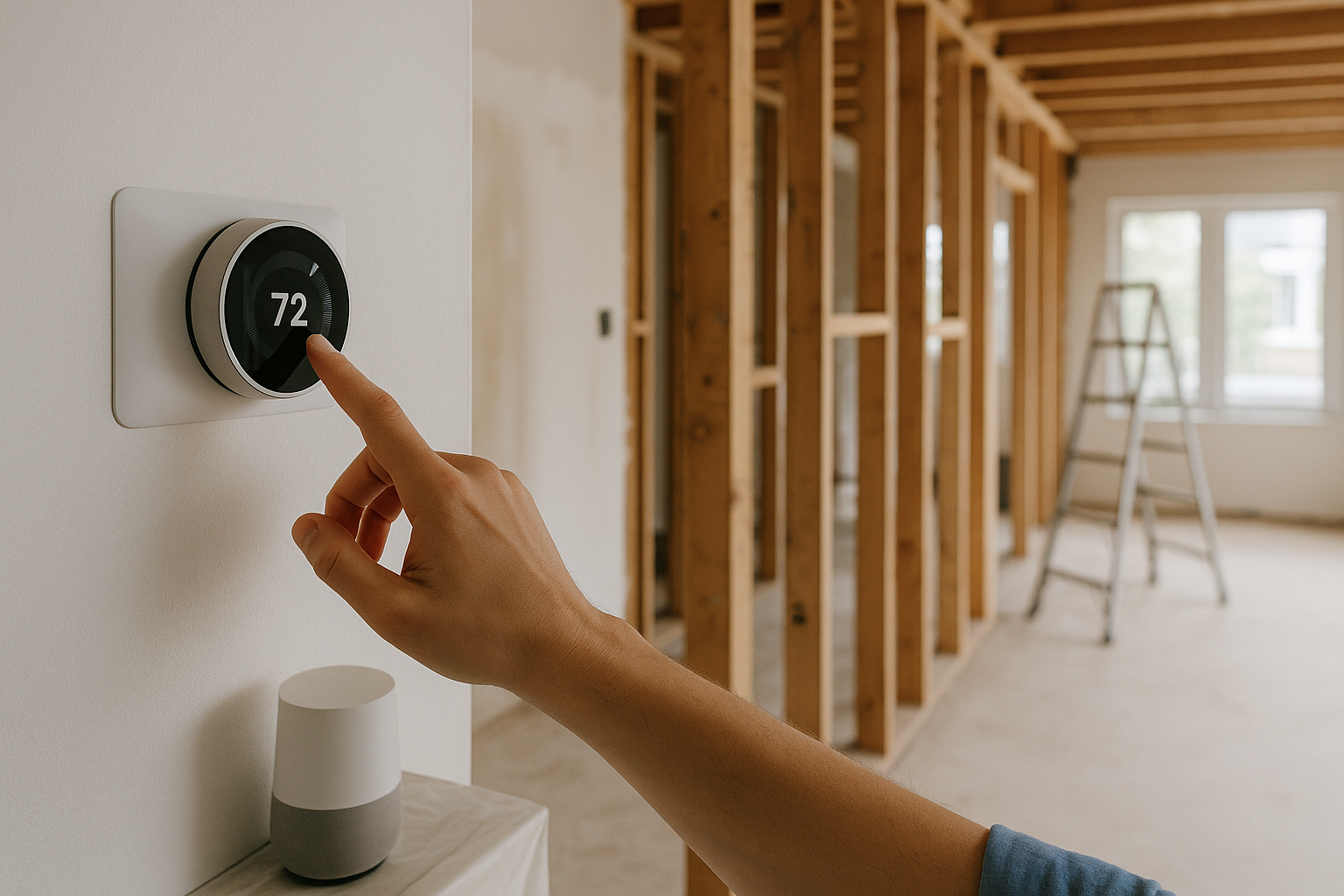
The window for smart home tech integration during a gut rehab is shorter than most homeowners expect: once insulation and drywall go in, adding a hardwired camera drop or an in-wall keypad costs five to ten times what it would have cost during rough-in. In a typical 2,000 square foot gut, that window lasts about seven to fourteen working days. The decisions you make in that stretch determine whether your house supports new devices in 2036 or fights you every time you swap a brand.
Open walls are cheap. Closed walls are expensive. That single fact should drive every choice below.
Low-voltage rough-in gets scheduled after framing and HVAC, alongside electrical, and it is almost always the trade that gets squeezed. If your general contractor has not asked you about network drops, door and window contacts, camera locations and speaker placement by the time the framing inspection is booked, you are already behind.
Homeowners who read up on what to expect during a whole-home renovation usually arrive at the same conclusion: the technology plan needs to exist on paper before demolition, not after. A one-page device schedule showing every drop by room is enough. Your electrician and low-voltage installer will price it faster and skip the change orders.
Mesh systems sell the idea that nothing needs cabling anymore, which is half true. Battery devices fail at the worst times, and Wi-Fi in a house with plaster, foil-faced insulation or a steel beam behaves unpredictably. The reliable approach is to hardwire the backbone and stay wireless at the edges.
At minimum, pull Cat6 or Cat6A to every television location, every ceiling access point, each exterior camera position and the two or three spots you might later want a wall-mounted touchscreen. Add two spare conduit runs (three quarter inch smurf tube) from the basement to the attic. That empty pipe is the single most valuable thing you can install, and it costs roughly $150 to $400 during a gut rehab.
A gut rehab usually adds load: induction range, heat pump, EV charger, plus a rack of always-on equipment. Plenty of older Montgomery County and Bucks County homes still run a 100-amp service that was fine in 1978 and is not fine now. Service upgrades to 200 amps commonly run $2,500 to $4,500 installed, and doing it while walls are open saves a second mobilization. Our write-up on upgrading a home’s electrical panel for modern appliances covers the load-calculation side in more detail.
For the network, frame a dedicated space: a 14-inch deep closet, a 30-inch structured wiring enclosure, or a small rack in a conditioned basement corner. Everything terminates there. Skipping this step is the reason so many finished basements end up with a router balanced on a joist.
Choosing a platform used to mean locking yourself into one brand’s app forever. The Matter standard from the Connectivity Standards Alliance softened that, and by 2026 most major lighting, lock, sensor and thermostat manufacturers ship Matter-compatible hardware that will talk to Apple Home, Google Home, Amazon Alexa and SmartThings at the same time.
Thread, the low-power mesh Matter often rides on, needs border routers spread through the house. Those are usually speakers, hubs or smart displays, and they want power and ideally Ethernet. Plan two to four Thread border router locations on different floors during rough-in rather than hunting for outlets later.
One caution worth repeating: heavier subsystems like whole-house audio, professional security monitoring and high-end lighting control still live largely outside Matter. If you want Lutron-grade dimming or a monitored alarm, spec that system specifically and wire to its requirements.
Search for gut rehab smart home costs and you will find numbers ranging from a few hundred dollars to six figures, which is unhelpful. Here are ranges that hold up for a typical 2,000 to 3,000 square foot project in southeastern Pennsylvania, assuming the work happens while walls are open.
A sensible middle path for most gut rehabs lands between $8,000 and $20,000 all in. Spending less is entirely reasonable if you prioritize wiring and defer devices.
Scroll through renovation threads on Reddit and the complaints repeat with almost no variation. Nobody regrets extra Cat6. People regret the rest.
That last one is worth designing around. Every automated function should still work with a physical switch or a key, because guests, contractors and sitters will not download your app. Exterior devices need a maintenance thought too: camera lenses and sensor housings collect pollen and grime, so crews handling power washing in Souderton or power washing in Franconia/ should be told where the equipment sits before the wand comes out.
Once the wire is in and inspected, the finish trades take over. Patching, priming and painting around new keypads and speaker grilles goes faster when the crew knows what is behind the drywall, which is a conversation worth having with your painters in Lansdale, PA during the walkthrough.
The three most common downsides are device obsolescence (many products lose cloud support within five to seven years), privacy exposure from cameras and voice assistants, and dependence on your internet connection. Subscription creep is the quiet one: camera storage, monitoring and premium app features can add $15 to $60 per month. Hardwiring the backbone and choosing locally controlled devices reduces most of these risks.
A smart home integration is the link that lets separate devices act together, such as a door lock that triggers entry lighting and disarms the alarm in one step. Integrations happen through a hub, a platform like Apple Home or SmartThings, or the Matter standard. During a gut rehab, the integration plan determines which wires you pull, so it should be settled before rough-in.
Three trends stand out in 2026: broad Matter and Thread adoption across brands, local processing that keeps automations working when the internet drops, and energy management tied to heat pumps, batteries and EV chargers. Presence sensing using millimeter-wave radar has also largely replaced motion sensors in new installs because it detects a person sitting still. Expect more insurance-linked leak and freeze monitoring as well.
Common examples include smart thermostats, video doorbells, keyless door locks, in-wall dimmers and keypads, motorized shades, water leak sensors with automatic shutoff, hardwired cameras, and networked speakers. In a renovation, the higher-value items are the ones you cannot add later without opening walls, such as shade wiring and camera drops. Plug-in devices can always wait until after move-in.
Wolfpack Home Services coordinates the electrical, low-voltage and finish work so the smart home wiring gets done during rough-in instead of becoming a change order in month four. Call for a walkthrough while your plans are still on paper, and we will map the drops room by room with you.
From kitchens to roofs, I manage projects that transform your home.
