
September 3, 2026
Common Surprises When Remodeling an 18th-Century Bucks County Farmhouse
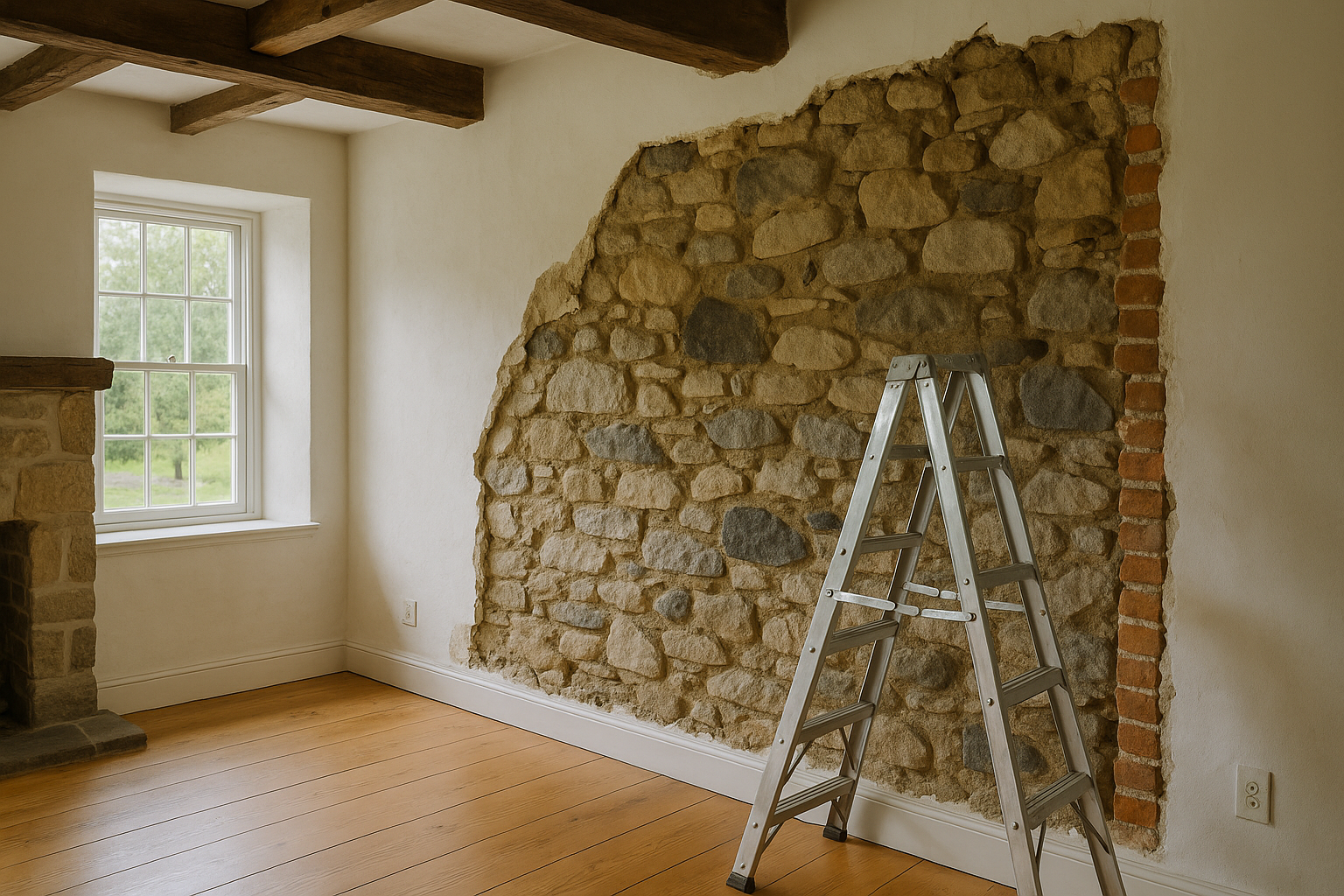
The common surprises when remodeling an 18th-century Bucks County farmhouse almost never show up on the inspection report. They show up on day three, when a crew pulls a section of plaster and finds hand-hewn joists sitting directly on fieldstone, or opens a closet and discovers the original exterior wall of a 1740s house. If you are budgeting a renovation on a stone home in Doylestown, Buckingham, Solebury or Tinicum, the difference between a smooth project and a painful one is usually how much you expected to find.
Wolfpack Home Services has worked on plenty of these houses across Bucks and Montgomery counties, and the pattern repeats. Below are the discoveries that come up most often, what they typically cost to address, and how to sequence the work so one surprise does not cascade into four.
Why These Houses Hide So Much
A farmhouse built between 1720 and 1800 in this part of Pennsylvania was rarely built once. Most grew in stages: a two-room stone core, then a summer kitchen, then a frame wing in the 1870s, then a bathroom carved out of a bedroom in 1948. Each generation built over the last without removing much.
That layering is why demolition is the most expensive unknown in any historic Bucks County renovation. You are not opening one wall assembly, you are opening three, and they were built to entirely different standards with entirely different materials.
Surprise 1: Someone Sealed the Stone With the Wrong Mortar
This is the single most common and most expensive discovery in old stone houses. Original walls were laid up with soft lime mortar that lets moisture move through the joints and evaporate. When a previous owner repointed with hard Portland cement in 1985, the water stopped leaving through the joints and started leaving through the stone itself, which spalls and crumbles.
You can usually read the history on the wall: bright gray tooled joints with eroded stone faces mean cement over lime. The National Park Service covers the correct approach in its Preservation Briefs on repointing historic masonry, and the fix is real work, not a weekend.
- Typical cost to rake and repoint with a lime-based mix: roughly $25 to $45 per square foot of wall face, depending on access and joint depth.
- Interior symptom to watch for: damp plaster or efflorescence two to four feet up the inside of an exterior wall.
- What not to do: spray a silicone sealer on the exterior, which traps moisture and accelerates the damage.
If your walls are showing this pattern, our write-up on masonry restoration and preserving Bucks County fieldstone goes deeper on mix ratios and timing.
Surprise 2: Nothing Is Level, Square or Standard
Framing in an 18th-century farmhouse was not laid out 16 inches on center. Joists are irregular, walls lean, floors slope a half inch or more across ten feet, and door openings often run 6 feet 2 inches instead of the modern 6 feet 8 inches. Cabinet and tile work take longer because almost nothing can be cut to a repeated dimension.
Expect scribing, shimming and custom filler pieces on every run. Kitchen installs in these houses commonly add 15 to 30 percent to labor hours compared with a 1990s colonial, which is worth factoring in before you read through kitchen remodeling costs in Bucks County and set a number.
The decision that saves money is choosing what to level and what to accept. Flattening an entire first floor can run $8,000 to $25,000 in sistering and self-leveling compound, while leveling only the kitchen and bath footprints often gets you 80 percent of the benefit.
Surprise 3: The Roof Has Three Lives Stacked On It
Many of these homes started with wood shake, moved to slate, then got asphalt laid over furring strips. Tear-off weights and disposal costs climb fast, and slate that looks failed is sometimes just missing fasteners.
The other frequent find is the porch or summer kitchen roof, where a low-slope section was never properly flashed into the stone wall. Water tracks behind the flashing, runs down inside the masonry and shows up as an interior stain nobody can source.
- Slate repair on a sound roof: often $600 to $2,500 for targeted slate and flashing work.
- Full tear-off with a second layer plus decking repair: commonly $1.50 to $3.00 per square foot more than a standard tear-off.
- Counterflashing cut into stone is a specialty detail that surface-mounted flashing cannot substitute for.
Our team handles this work through roofing services across Montgomery County, PA and neighboring Bucks townships, and it is usually the first line item we recommend addressing. There is also a practical checklist in our post on preparing your Bucks County roof for spring showers.
Surprise 4: Lead Paint, Asbestos and Horsehair Plaster
Any house predating 1978 is presumed to have lead paint, and an 18th-century farmhouse will have it in dozens of layers on trim, sashes and doors. Contractors disturbing more than six square feet of interior painted surface must be certified under the EPA Renovation, Repair and Painting rule, which affects containment, cleanup and cost.
Asbestos turns up in 1950s floor tile, pipe insulation and some old siding, and testing runs about $50 to $125 per sample. Horsehair plaster over split lath is not hazardous, but it is heavy, brittle and expensive to patch well.
Homeowners often assume plaster should be torn out for drywall. Keeping and repairing sound plaster usually costs less than a full gut, holds the original wall texture, and avoids disturbing lead-painted trim. When repainting historic woodwork, our crews follow lead-safe practice on jobs through our painting services in Perkasie and surrounding areas.
Surprise 5: Mechanical Systems Patched Across Three Centuries
Stone walls leave nowhere obvious to run ductwork, wiring or plumbing, so previous owners improvised. Common finds include knob-and-tube wiring still live in a ceiling bay, a buried oil tank in the side yard, cast iron waste lines packed into a chase, and a chimney flue that was never lined after a coal stove came out.
- Unlined chimney: stainless liner installs typically run $2,500 to $6,000 depending on height and offsets.
- Knob-and-tube removal: often $8,000 to $20,000 for a full rewire on a 2,200 square foot farmhouse.
- Buried oil tank removal: commonly $1,500 to $4,000, higher if soil testing shows contamination.
Interior insulation is its own judgment call. Spray foam applied directly to the inside of a stone wall can trap moisture in the masonry and worsen freeze damage, so vapor-open assemblies are the safer choice in these homes.
Surprise 6: The Water Problem Starts Outside
Dirt-floor basements, springhouses and 250 years of settled grading mean most old farmhouses have some water intrusion. Before anyone quotes interior waterproofing, check the simple things: downspouts dumping at the foundation, a driveway pitched toward the house, and patio slabs that have heaved.
Correcting exterior grading and extending leaders 8 to 10 feet out solves a meaningful share of wet basements for a few hundred dollars. Where a patio or walk needs to be rebuilt with proper pitch away from the stone, stamped concrete work in Montgomery County, PA can handle both drainage and appearance in one pass.
Surprise 7: Review Boards, Permits and Setbacks
If the home sits in a historic district, exterior changes such as windows, roofing material and additions may need review before a permit is issued. Doylestown Borough, New Hope and several townships maintain review processes that can add four to eight weeks to a schedule.
Additions on old parcels also run into non-conforming setbacks, septic capacity limits and floodplain lines along the Delaware and Neshaminy. Read our overview of zoning rules for home additions in Doylestown Borough before you finalize a footprint.
Budget and Sequence: What Actually Prevents Disasters
Carry a contingency of 15 to 25 percent on any pre-1800 house, not the 10 percent typical for newer construction. Then sequence the work so the building envelope is sound before finish money gets spent.
- Roof, flashing and chimney first, because everything below depends on it.
- Masonry repointing and exterior grading second, to stop moisture at the source.
- Mechanicals, framing corrections and insulation third, while walls are open.
- Plaster, trim, paint and finishes last, once the house has gone through at least one wet season dry.
Owners who reverse that order end up repainting a dining room twice. Owners who follow it usually spend less overall, even when the early phases feel unglamorous.
Frequently Asked Questions
What trend is replacing modern farmhouses?
Warm transitional and “new traditional” interiors have largely replaced the black-and-white modern farmhouse look since roughly 2023. Designers are moving toward stained wood, layered antiques, softer color and English cottage influences, which suits an authentic old farmhouse better than shiplap and barn doors ever did.
Why are old farmhouses white?
Most were finished with lime whitewash, which cost only pennies per gallon and was reapplied annually. Whitewash also let stone and plaster breathe, reflected summer heat and had mild antibacterial properties, which made it standard on both houses and outbuildings across Pennsylvania.
Who were the early settlers of Bucks County, PA?
Bucks County was established in 1682 as one of William Penn’s three original counties, on land long inhabited by the Lenape. Early European settlers included English Quakers, Welsh and Scots-Irish families, German-speaking immigrants who brought the bank house form, and earlier Dutch and Swedish traders along the Delaware.
What are the different styles of old farmhouses?
The four most common historic farmhouse types in Bucks County, Pennsylvania are the Pennsylvania German bank house, the Georgian stone farmhouse, the Federal-era center hall, and the later Greek Revival or Victorian farmhouse. Many local houses blend two or three of these because wings were added decades apart.
Planning Work on a Historic Farmhouse?
If you own an old stone home in Bucks or Montgomery County and want an honest read on the roof, masonry and drainage before you commit to a full renovation, Wolfpack Home Services has lovingly helped owners protect these houses for years. Call us to walk the property and get a phased estimate you can actually plan around.
Enjoying this article? Add Wolfpack Home Services as a preferred source on Google to see more of our posts in your Top Stories.Prefer us on Google
Related Posts

August 28, 2026
August 20, 2026
August 18, 2026
August 18, 2026
April 21, 2025